
Bridge SAP Governance
with Jira Cloud
R2D ALM for Jira brings SAP’s proven Requirements-to-Deploy Agile process into ready-to-use Jira Cloud functionality for managing S/4HANA transformations and similar large scale SAP programs
Not an app,
not a service
R2D ALM for Jira is a complete Requirements-to-Deploy Agile framework that combines SAP Activate process, system documentation, and team training in one integrated solution package.
Who is it for?
One package, One price
Ready to use from Day One
Pre-configured workflows, method documentation and training materials on how to use the system and process, so you can start with a ready to use SAP Agile Management from day one. The structure of SAP Activate and Focused Build process is already built into Jira.
SAP structure without lock-in
R2D ALM brings SAP project governance, traceability, and best practices into Jira without locking you into Solution Manager or waiting for Cloud ALM to mature. You stay in control of your toolset, free to customize it or extend it as you needs will evolve over time.
Future-proof platform
Jira and Confluence are modern, cloud-native, and trusted worldwide by enterprises of every size. You can adopt them quickly for your SAP program and keep using them long after go-live for IT services, DevOps, and other business processes.
About solution
Features of R2D ALM for Jira
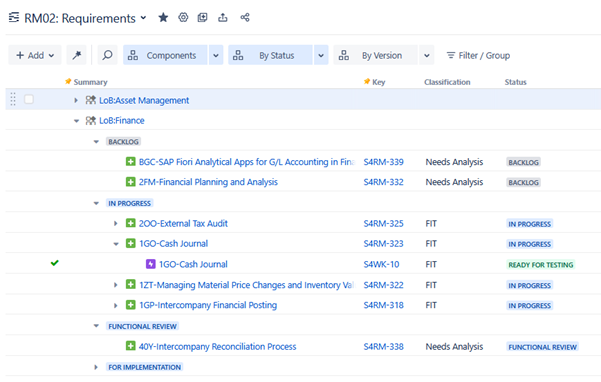
01. Scope planning
Plan and control your SAP program scope before your project begins
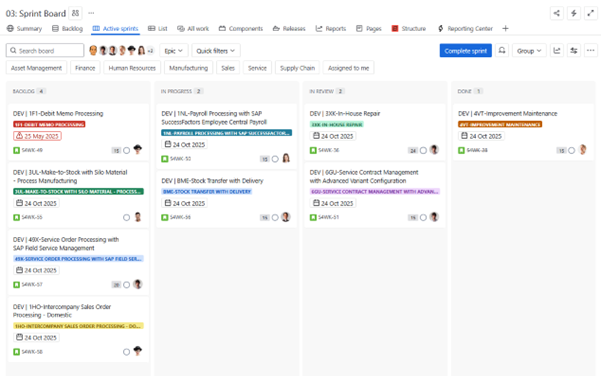
02. Delivery management
Keep delivery organized, measurable, and transparent for all stakeholders
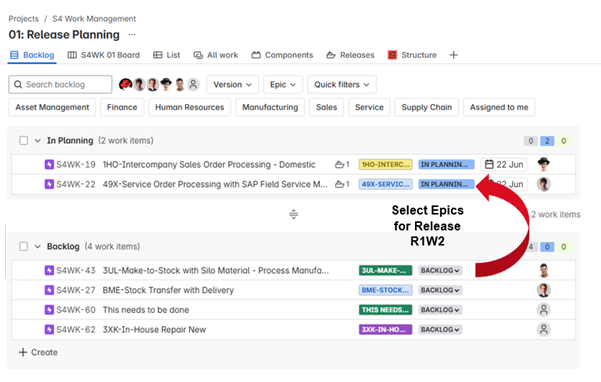
03. Release management
Manage Releases the hybrid way with SAP Activate Phases and Agile iterations
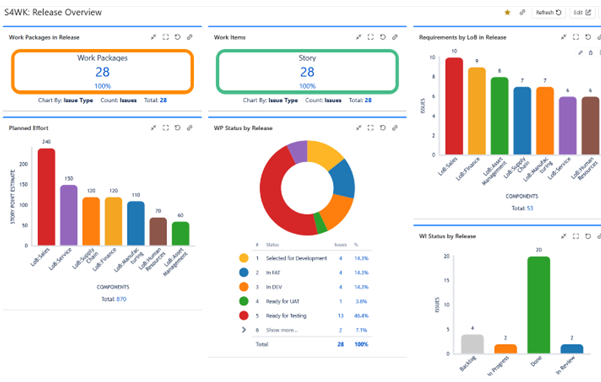
04. Status reporting
No more manual PowerPoint decks
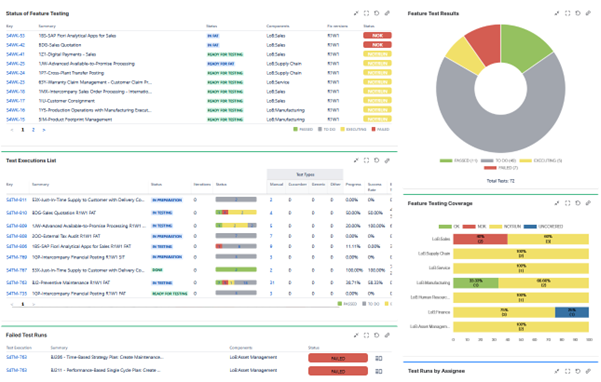
05. Test management
Ensure results quality with fully integrated test planning and execution
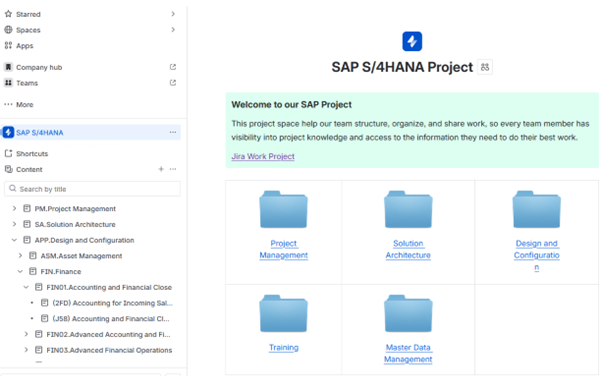
06. Documentation management
Bring process and project knowledge together
180-day guarantee after implementation
Every piece of configuration is validated against a set of detailed Test Cases to ensure that workflows, automations, dashboards, and documentation function on your Jira instance exactly as intended. For six months after delivery completion, it is guaranteed that the implemented configuration will continue to work as delivered*
* provided it is not modified by other Jira Administrators and Atlassian or Apps vendors do not introduce critical changes to the underlying platform. The guarantee does not cover third-party actions outside of my control such as outages or feature critical changes in Atlassian Cloud, or unauthorized modifications made to the configuration after handover. Your team remains responsible for standard practices such as backups and data maintenance.
bonus materials
You'll get a complete knowledge pack
Apart from the implementation, with R2D ALM for Jira you get a complete knowledge package, which ensures that your team owns the process, training and system from day one
R2D Process documentation
A Confluence knowledge base that explains every step of the Requirements-to-Deploy process. It’s not just theory — it’s written for your team to follow in real SAP project delivery. And because it’s hosted in your Confluence, it can grow into your local knowledge base, updated and expanded over time.
Solid training documentation
Highly visual slides that show how the process works at a glance (not walls of text). Additionally, hands-on exercises where participants practice real steps in Jira. To supplement that, recordings and guides to ensure learning sticks beyond the training workshops.
This is training that transforms — not just presentations.
Configuration technical documentation
A detailed technical manual (200+ A4 pages) describing every single configuration element. This means that your local Jira admins can understand and maintain the solution. If you ever need customization later, any qualified Atlassian consultant will understand how it was prepared. No black-box dependency. No vendor lock-in.
WORKING TOGETHER
A short path to full implementation
Introductory call
In this short 30-minute call, we’ll review your SAP project challenges and goals. You’ll walk away with more clarity on whether R2D ALM for Jira is the right fit. After the call, you’ll also receive supporting materials (in English) to decide if you would like to learn more during the Discovery Workshop.
We can talk in English, German or Polish.
Deep dive
Full step-by-step guidance
Each component serves a specific purpose helping us in a successful introduction of this toolset to your team
Discovery Workshop & Demo Access
Configuration in Jira Cloud
Process Documentation
Jira Cloud Technical Documentation
Training & Enablement
Post-Go-Live Support
Customization Services (optional)
USE CASES
R2D ALM for Jira already works
Since 2022, I have worked closely with project teams to refine and strengthen R2D ALM for Jira, a configuration tested and proven in real SAP transformation programs
Automotive Industry
In 2022 one client needed a tailor made solution and process for their global rollout of SAP SuccessFactors. This was the first implementation of what was called "Focused Delivery" at that time. This solution helped the client structure Change and Release Management, replacing Jira configuration which was not prepared to follow the SAP methodology process.
Consulting Industry
A Consulting company decided to implement a smaller ERP solution called SAP by Design. They needed a process to organize their collaboration with an external SAP consulting company. The approach used now in R2D ALM for Jira proved that the framework scales even to smaller SAP projects.
Healthcare Industry
The requirement of this client was clear from the beginning - keep the logic and process from Focused Build but adapt it to a modern platform Atlassian Jira Cloud. The project delivered full release traceability and additionally enabled process and technical integration with SAP TMS.
Technical Services Industry
This client was preparing themselves to a SAP transition to SAP S/4HANA and needed a process and toolset to help them organize and coordinate this project. Jira was already familiar to some team members. R2D ALM for Jira gave them a clear SAP Activate-based delivery structure and integrated test management ahead of their SAP S/4HANA transition project.
Clarity in your SAP project is within reach
WHY R2D ALM for Jira
The story behind R2D ALM for Jira
SAP’s Focused Build methodology is powerful and proven in practice in many projects. The problem was the tool - the Solution Manager. This tool can't be adapted and now is set to be phased out. SAP Cloud ALM, while promising, is not flexible and too limited for real-world enterprise needs. At the same time, many organizations already use Atlassian Jira but in a generic, unstructured way that doesn’t fit SAP projects.
I saw this gap and built R2D ALM for Jira: a way to retain the strengths of Focused Build and SAP Activate, but deliver them in Jira Cloud and Confluence Cloud which are modern, flexible, and user-friendly platforms that teams actually like to use. The configuration was used in a few smaller and bigger SAP projects already and is continuously refined to better versions.

about creator
Who created R2D ALM for Jira?
Hi, I'm Bogdan Górka and I'm the creator of R2D ALM for Jira, a framework born out of years of working at the intersection of SAP project governance and Atlassian technology.
I have got:
Frequently Asked Questions
Most Jira setups are generic or follow only a simple task management process. They lack SAP Activate governance, SAP Focused Build structure, and end-to-end Requirement to Deploy traceability. R2D ALM for Jira is not “just another Jira project” it’s a pre-configured internally integrated framework that makes Jira fit for SAP S/4HANA projects.
SAP Cloud ALM is a strong step forward compared to Solution Manager. It’s cloud-based, simpler to get started with, and aligned with SAP’s roadmap for the future. For many teams, it promises easier onboarding and a lighter technical footprint. Currently Cloud ALM is evolving but is still limited and less flexible, so you will need to wait before it delivers what it promises. With R2D ALM for Jira, you can manage your S/4HANA project today, in a proven tool your teams may already use or will quickly learn. Later you can decide if and how Cloud ALM fits into your landscape. You’re not locked in.
Focused Build embedded in Solution Manager is robust and solid as a method, but Solution Manager is being phased out in 2027. R2D ALM for Jira preserves the strengths and structure of Focused Build, but delivers it in Jira Cloud. A modern, user-friendly, and future-proof platform that is also available for the Service Management, needed later for SAP landscape maintenance.
The framework is based directly on elements derived from SAP Activate and SAP Focused Build process. It’s not theory: it has been tested in real-world S/4HANA transformation scenarios, and mirrors the way SAP programs are governed but with Jira’s flexibility and attractive UX.
R2D ALM for Jira is designed primarily for SAP S/4HANA implementations. However, the framework is scalable and adaptable to other SAP systems such as SuccessFactors. The key is alignment with SAP Activate and SAP Roadmaps - if SAP has published a roadmap and the project follows SAP Activate methodology, this framework can support such implementation.
Not at all. The solution is technically well and detailed documented in Confluence, and your Jira administrators (or Atlassian services vendors) have complete control. You own the license to use the configuration, no black box, no hidden dependencies. Optional support and customization are available, but never mandatory. You can hire any Atlassian consultant for this purpose.
R2D ALM for Jira is delivered and implemented together with your team in the shortest possible time. The most important is the motivation of your team and the PMO, especially the SAP Project Manager. The implementation itself is transparent and quick: you see the ready-to-use configuration in action, you learn how to use it yourself during hands-on workshops, you learn more from recorded videos, you get the process documentation, you control the final setup. Every milestone is measurable and transparent. There will be no “let me hear your requirements” during endless workshops. You simply get what you saw. If the team is engaged, the time needed to introduce the framework in practice in your project will be really short, most likely within 4 weeks.
Email: info@pmbg.eu
Project Inquiry
© PMBG.EU Bogdan Górka 2025
Disclaimer: PMBG Bogdan Górka is not affiliated with or endorsed by SAP AG or Atlassian. Read full Disclaimer.