
If you have never taken part in any SAP project before, you can safely assume that you are not yet competent enough to fulfill your role in a large ERP system implementation like SAP S/4HANA. However, you can start your preparations now. Here is my subjective list of the top three project governance elements that every Project Sponsor or Project Manager should be familiar with before starting an SAP project.
Project Scope
The concept of ‘project scope’ is one of the first terms that should be well understood by a project team. You do your scope planning by listing what you are actually delivering. A good example is a working business process in the SAP system. This process can be then represented in Jira, as so called Scope Item (or Project Objective) and will be tracked there throughout the entire project lifecycle. Tracking the delivery status of Scope Items is the main purpose why you may want to use Jira as you project management tool.
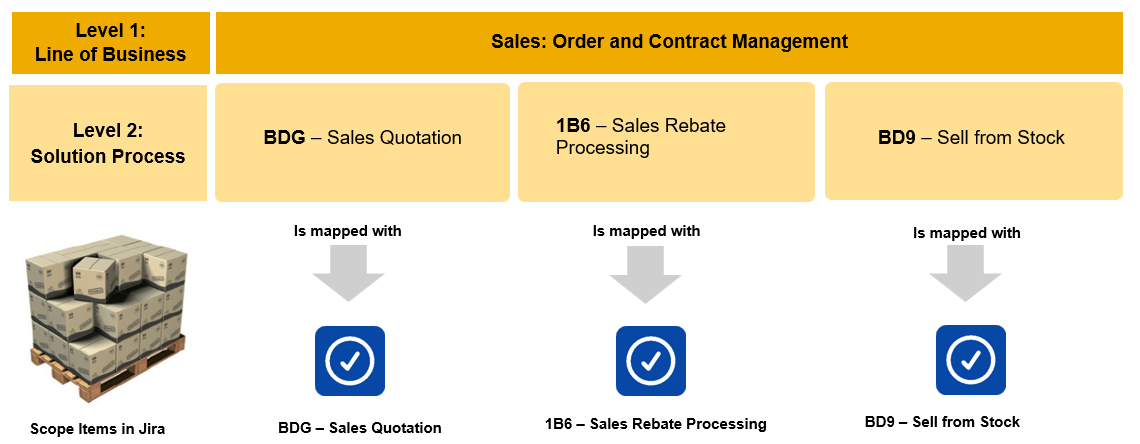
Mapping SAP processes with Jira issues type 'Scope Item'
Note: The tool used to manage the SAP project scope does not have to come from SAP (eg. SAP Cloud ALM). For the purpose of managing SAP project I have successfully used Atlassian’s Jira and Confluence, and this toolset you may already have in your company.
Coming back to Scope Management, this approach is aligned with the SAP Activate methodology and offers three levels of Scope Management organization:
- Scope Item (or project objective)
- Work Package
- User Story or Task
Below is an example of organizing a delivery of a working business process in SAP S/4HANA: BD9 - Sell from Stock.
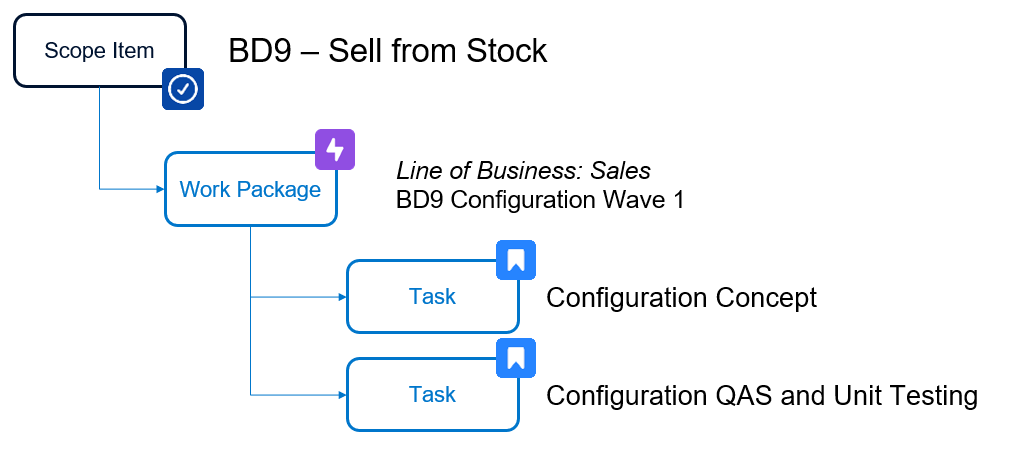
SAP project scope organization hierarchy
Project Phases
In the new SAP Activate concept, we also use phases, but they are used to control the stages of a Project Release and not the whole project. Some phases happen only once in a major productive release: Discover and Prepare at the beginning of such a release, and Deploy and Run at the end of a this release.
The phases Explore and Realize (with Testing) may happen as many times as needed and be grouped into so called 'non-productive releases' (also known as Waves).
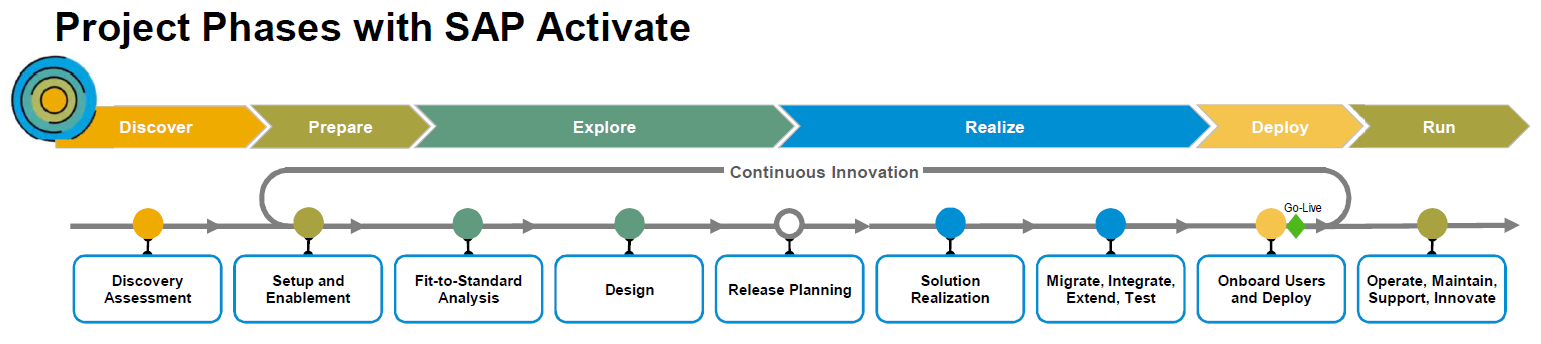
Project Phases in SAP Activate Source: SAP
In Jira, project phases can be managed as part of Release Management using the field 'FixVersion' as well as the naming conventions while creating Objectives and Work Packages. Also, robust labeling or custom fields can be used for that purpose.
Milestones
Milestones are another well-known aspect of project management. SAP Activate helps in understanding them, and Jira can greatly help in tracking them.
For me, the most important thing is to understand that a Milestone is this moment when all deliverables planned for that time are completed. It is like a general checkpoint to ensure, for example, that all Functional Specification Documents in all modules are done, all Configuration Objects in the system are done, and all Single Functional Tests are completed.
It is also good to understand the concept of ‘Definition of Done (DoD)’ from Agile methodologies. This concept can be used to clearly define what will be checked or tested to mark a deliverable as 'Done'. In Jira you can use Checklists to define your criteria in Work Packages and/or Tasks.
You can plan milestones and checkpoints on a project level, release level, or sprint level, addressing the controlling needs of different management levels in your SAP project. To make it transparent for decision-makers, you can use a Milestone issue type in Jira, which will be automatically moved forward or backward on the Gantt Chart.
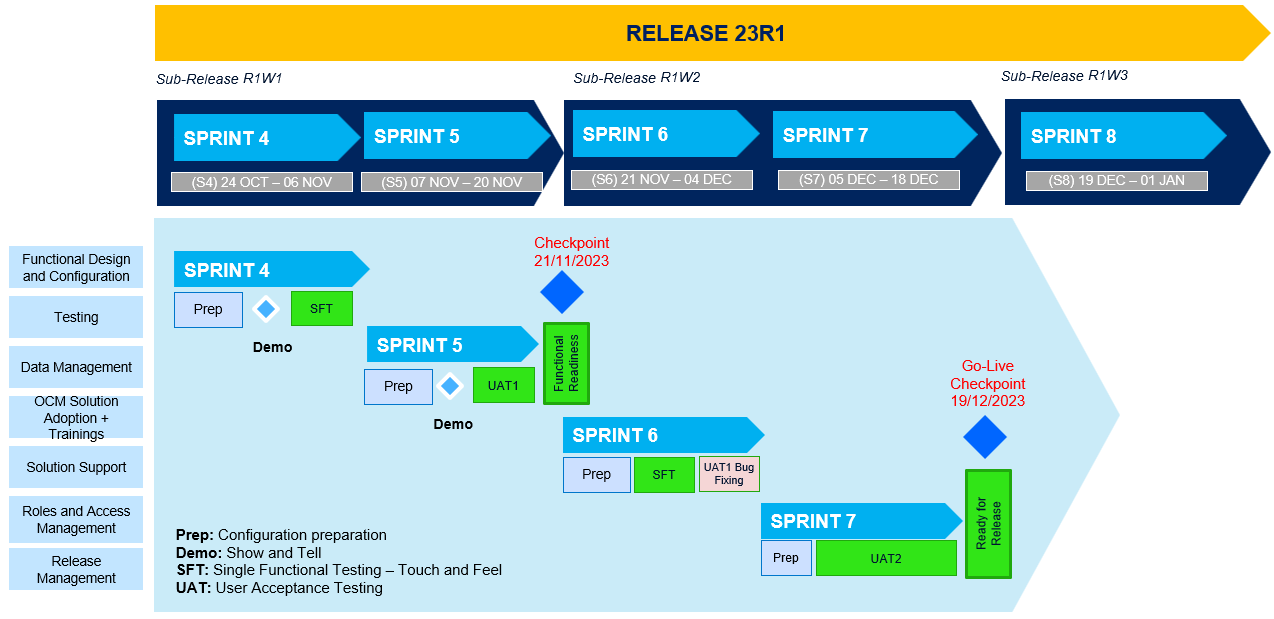
Organizing Milestones and Checkpoints in a release
Quality Gates (Stage Gates) for Project Committee
The concept of Stage Gate meetings is very useful in SAP projects and other large-scale projects. A Stage Gate is a formal quality-check meeting where the professional services vendor and project team jointly present that the agreed ‘Definition of Done’ (DoD) criteria for the current project phase have been achieved. After presenting their work, the team requests permission to start the next phase, which can be linked to the release of project funding for the upcoming period.
It is often unclear to Project Sponsors that they should be prepared to ask the right ‘quality questions’ about specific input materials. Like any other project team member, a Project Sponsor also needs a framework to perform their role effectively. Such meetings are also organized between phases in minor releases, referred to as ‘the Waves’ in the Focused Build method.
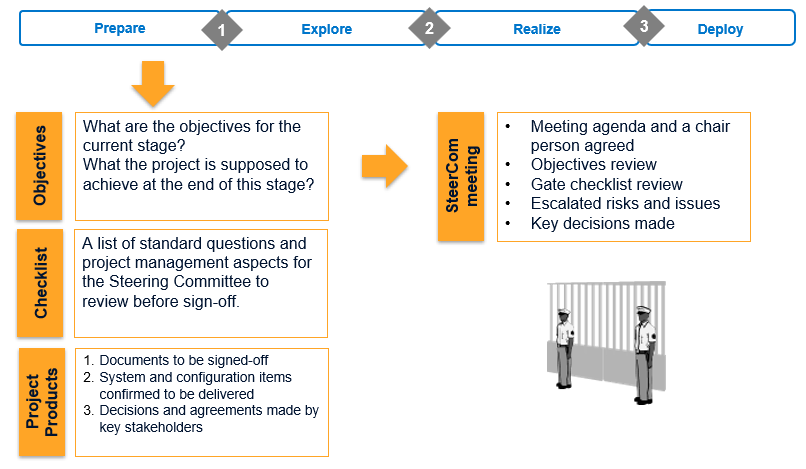
Stage Gates for Project Committee
Agile Release and Time Windows
Some time ago, Agile and iterative delivery methods have also been introduced to the traditionally waterfall world of SAP project management. Detailed task planning with Gantt Charts has now been replaced by “time windows.” What are these? They are time segments that your team can use to plan what will be delivered during that period.
The smallest segment of time used for planning is called a “Sprint.” Several sprints are combined to plan a higher-level goal, known as a Wave (or sub-release). Multiple Waves should achieve the goal of the main Release. So, just like an app on our cell phones, the SAP Solution can also be released in several time windows, with the largest of these windows being called a Release (also known as a solution version).
Business Transformation
And lastly, SAP systems bring the know-how about best practice business processes. An SAP project is mainly about upgrading currently used business processes. During the SAP project, you are in the process of transforming your business—from old practices to new practices, from old non-standardized processes to new uniform and integrated processes.
During this transformation process, you also receive support from SAP. In the SAP Activate Roadmap, there is a complete workstream called ‘Solution Adoption,’ which includes topics like Organizational Change and Change Impact Analysis. These will help you avoid the basic mistake of having a completely new SAP solution that is not properly embedded in your business policies, procedures, and important certifications (like ISO).
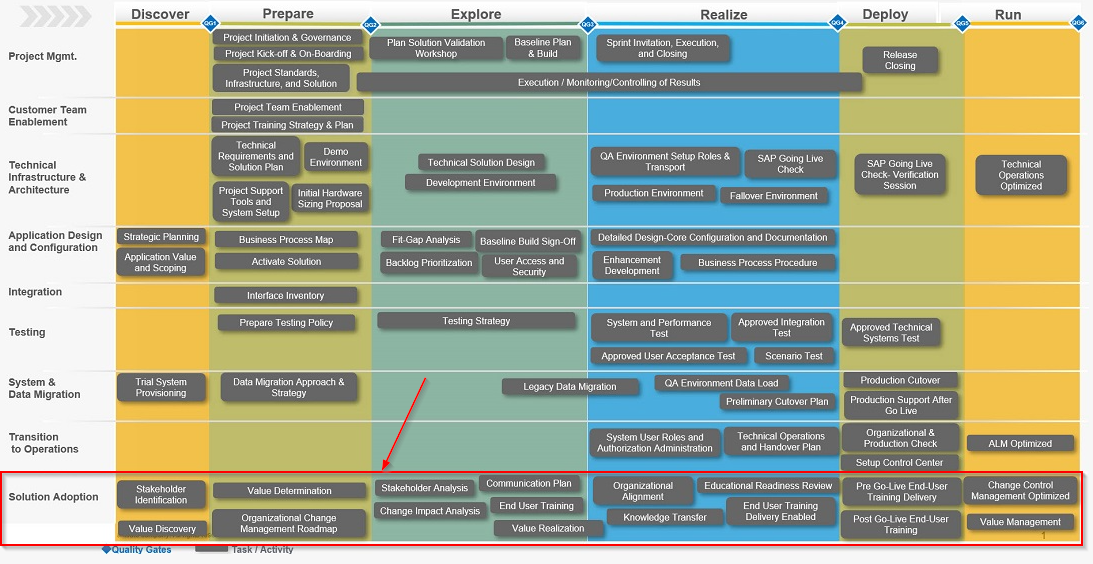
Source: SAP Roadmap
Get your C-Level trained before starting the SAP project
I am quite aware that many concepts mentioned in this article may not yet be familiar to a C-Level executive who has been assigned as an SAP Project Sponsor.
The Project Sponsor is just another project role for which the assigned person needs specific training. Never assume that you are fit for a project role just because you have many years of business experience.
It is best to be trained for this critical role before selecting the implementation partner, as this will help build awareness before making a selection.
More information
You can find more information about mentioned methodologies in the following presentations:
Get in touch
Get in touch with me if you are interested in managing your SAP project with Jira and Confluence using methods from the Focused Build and SAP Activate Methodology.
